India’s first bullet train was financed at 0.1 percent on the assumption that it would open in 2023 and earn about 4 percent as a business. The viaducts are going up. The opening date, the bill, and the technology package have all moved.
 Illustration. The Mumbai–Ahmedabad line is still under construction. This picture is not a photograph of the project.
On 12 December 2015, India and Japan agreed to build a 508-kilometre high-speed line from Mumbai to Ahmedabad with Shinkansen technology. The feasibility study put the completion cost at ₹97,636 crore. Japan offered assistance of more than ₹79,000 crore, at an interest rate of 0.1 percent, repayable over 50 years, with no principal due for the first 15. The same study put the financial return at about 4 percent and the economic return at about 11.8 percent. [1] [3]
That 4 percent is the hinge of the project. A railway that earns 4 percent on its capital can be financed when most of the money costs 0.1 percent, and when the trains start in the year the study assumed they would. The loan papers still had that year as 2023. [5] The line is still under construction. Railway officials have since told newspapers that the cost is nearing ₹1.98 lakh crore, a figure the implementing company disputes as a description of Japan’s obligations, and which the Cabinet has yet to adopt as a revised estimate. [9] [13] [15]
This article follows the two assumptions that made the original sum work: the price of the money, and the year the passengers were supposed to arrive.
How the corridor was chosen
Indian Railways had been listing high-speed routes since the 2007–08 Railway Budget. In December 2009, the Ministry’s Vision 2020 document called for high-speed tracks and included the Mumbai–Ahmedabad section among the priorities. [5] A pre-feasibility study of a longer Ahmedabad–Mumbai–Pune route was carried out by RITES with the Italian and French firms Italferr and Systra. In March 2013 the Railway Board dropped the Mumbai–Pune leg. The ghat section between the two cities would have made a first line far more expensive to build. [12]
On 29 May 2013 a joint statement by Prime Ministers Manmohan Singh and Shinzo Abe committed the two governments to co-finance a study of Mumbai–Ahmedabad on its own. The joint feasibility study ran from December 2013 to July 2015, under the Japan International Cooperation Agency and the Ministry of Railways. The consultants were Japan International Consultants for Transportation, Oriental Consultants Global, and Nippon Koei. [4] [5]
The distance is why this pair of cities came first. High-speed rail earns its advantage somewhere between 300 and 600 kilometres: long enough that a road journey is exhausting, short enough that a flight loses its edge once the passenger has travelled to the airport and from it. Mumbai–Ahmedabad sits in that band. Mumbai is the country’s financial capital. Ahmedabad, Surat, and Vadodara are industrial cities. JICA recorded that Maharashtra and Gujarat were growing faster than the national economy, and that about 85 percent of travel between Mumbai and Ahmedabad was then by car or bus. The existing Western Railway was already a capacity problem, so the new line was planned as its own railway, on its own alignment. [5] [12]
A sense of scale helps. The Tokaido Shinkansen, from Tokyo to Shin-Osaka, is 515.4 kilometres, almost the same length as Mumbai–Ahmedabad. The Tohoku Shinkansen, from Tokyo to Shin-Aomori, is 674.9 kilometres, the longest single line on the Japanese network. Beijing West to Guangzhou South, the longest line on China’s high-speed network, is 2,298 kilometres. India’s first corridor is the length of Japan’s original trunk. It is a first link, not a national spine.
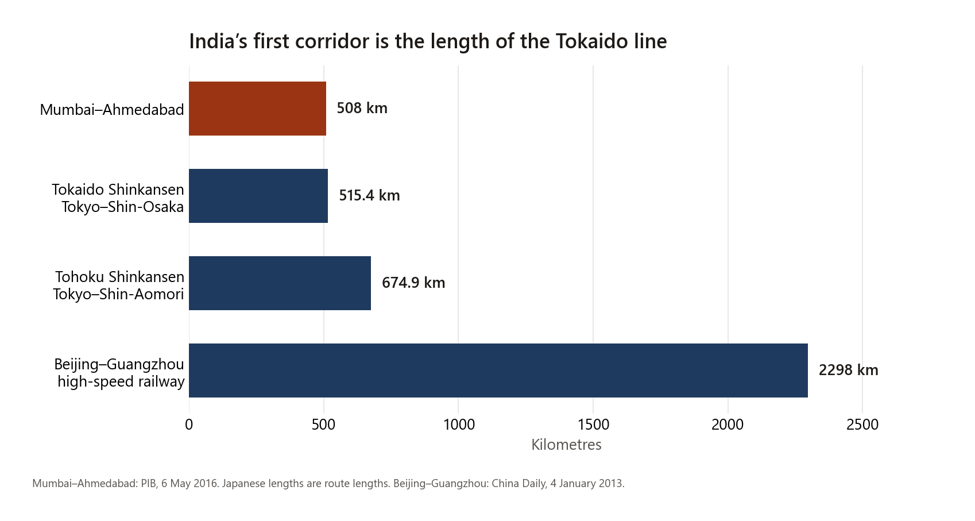 Figure 1. Route length, in kilometres. Mumbai–Ahmedabad is drawn against the longest single Shinkansen line and against the longest line on China’s high-speed network.
What the 2015 memorandum covered
The paper signed on 12 December 2015 is a memorandum of cooperation. It is not a turnkey contract. The Ministry of External Affairs described it as cooperation on the Mumbai–Ahmedabad corridor using Japanese high-speed rail technology, with financial and technical assistance from Japan. [2] The Railway Ministry’s note the next day set out the terms that were to govern the work. Shinkansen technology would be adopted. Cooperation would be fixed on transfer of technology and on Make in India. Japan would help train Indian personnel for high-speed rail. The line would be 508 kilometres, the cost ₹97,636 crore, and the implementation period seven years. The loan would run for 50 years, with a moratorium of 15 years, at 0.1 percent. Japan’s assistance would exceed ₹79,000 crore. [1]
Two other agreements, signed on 11 December 2015, concerned the modernisation of the existing Indian Railways. They belong to a different file.
The memorandum also left a great deal unsettled. It did not name the civil contractors. It did not award the trains. It did not fix the signalling standard. It did not lock a Cabinet cost after detailed design. It committed India to a Japanese system, and Japan to cheap money, technology, and training. The arguments that arrived a decade later, over a European signalling contract and Indian-built trains, are arguments about whether that package is still the one the two governments signed.
One figure needs care from the start. The National High Speed Rail Corporation later described Japan’s share as about 81 percent of the project cost. That percentage belongs to the estimate then on the table. It is not, on the face of the 2015 note, a promise to fund whatever the corridor later costs. [1] [9]
Who borrows, and who builds
The yen is borrowed by the President of India. It is debt of the Government of India. The organisation that builds the line, and is meant to run it, is the National High Speed Rail Corporation Limited, incorporated on 12 February 2016 to finance, construct, maintain, and manage high-speed corridors in the country. Equity is split 50 percent to the Ministry of Railways, 25 percent to the Government of Gujarat, and 25 percent to the Government of Maharashtra. The states are owners of the company. They are not the borrowers of the yen. [5] [9]
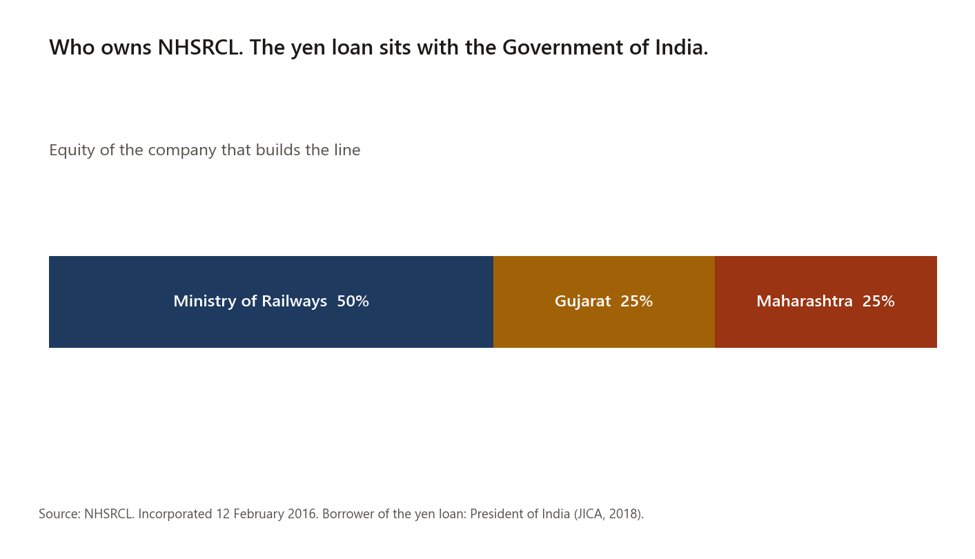 Figure 2. Equity in the company that builds the line. The yen loan is debt of the Government of India, not of the two states.
NHSRCL’s own project page still describes a project of ₹1,08,000 crore excluding taxes, with about 81 percent funded by the Government of Japan through JICA and the remainder by the Government of India. The loan, it says, runs for 50 years with a moratorium of 15. That is the company’s standing description. The higher figure discussed in the press in 2026 is a separate claim, and it is treated below. [9]
The work is split in a way the public language often blurs. Viaducts, stations, and the tunnel are Indian civil contracts. Project descriptions say nearly 90 percent of the route is elevated. Japan’s role in the early years was the feasibility study, the detailed design carried out from December 2016 to March 2020, construction supervision, and training. A separate loan of ¥10,453 million, signed on 15 September 2017, paid for a high-speed rail training institute, again with NHSRCL as the executing agency. Japanese engineers were posted to the company. [5] [6]
The equipment Japan expected to supply was the rolling stock, the signalling and communications, and the operations control centre. Those packages are the ones that later came apart. Japan is financing a sovereign project and transferring a system. Indian contractors are building the line.
The route
The line runs 508 kilometres from the Bandra-Kurla Complex in Mumbai to Sabarmati in Ahmedabad, through Maharashtra, Dadra and Nagar Haveli, and Gujarat. There are twelve stations: Mumbai (Bandra-Kurla Complex), Thane, Virar, Boisar, Vapi, Bilimora, Surat, Bharuch, Vadodara, Anand, Ahmedabad, and Sabarmati. [3]
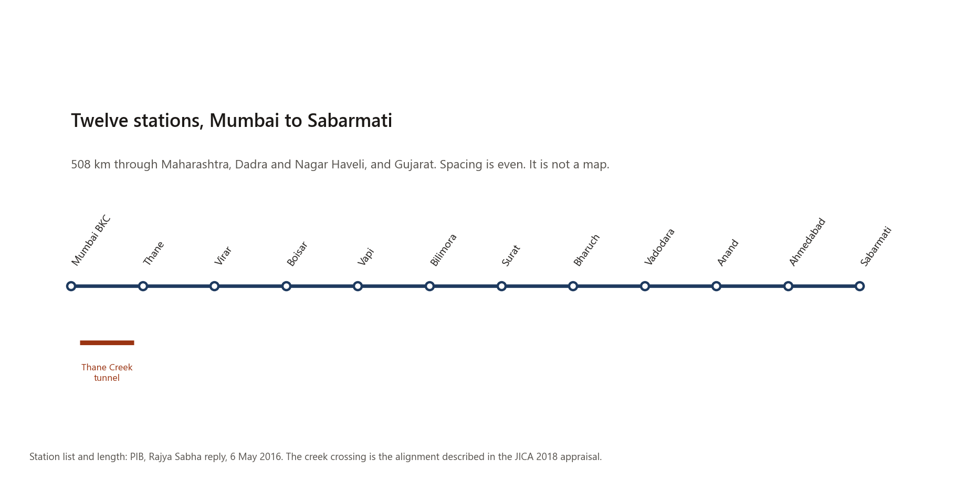 Figure 3. The twelve stations in running order. The gaps are equal on purpose. This is not a map, and it does not show distance.
The feasibility report, as the government placed it before the Rajya Sabha in May 2016, put a fast train at 2 hours 7 minutes and a train stopping at every station at 2 hours 58 minutes. An express on the existing line takes on the order of seven hours. JICA’s loan evaluation later used a target journey of 127 minutes, against about 420 minutes on the conventional express. The 127 minutes and the Rajya Sabha’s 2 hours 7 minutes are the same clock. [3] [5]
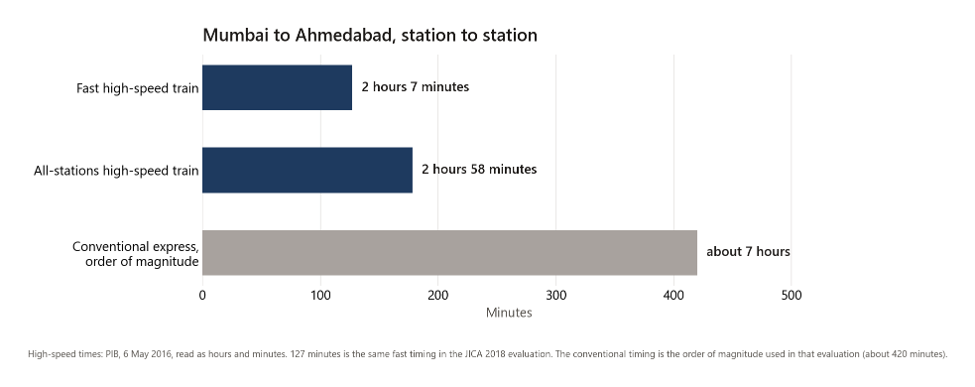 Figure 4. Station-to-station time the studies used. The conventional bar is an order of magnitude, about 420 minutes, from the JICA evaluation.
The alignment is a new railway. It does not share the old tracks. It runs on viaduct for almost the whole distance, with a tunnel in Maharashtra, including a crossing under Thane Creek. Planners compared alternatives on seven tests: how the stations would meet city transport, how attractive they would be to passengers, the environmental impact, the engineering, how quickly the line could be built, how many people would have to move, and the cost. The scheme that was chosen starts at Bandra-Kurla Complex, crosses the creek in tunnel, and ends at Sabarmati.
The tunnel is an environmental decision as well as an engineering one. The alignment passes the Thane Creek Flamingo Sanctuary, the buffer of Sanjay Gandhi National Park, and the buffer of Tungareshwar Wildlife Sanctuary. Setting the railway in a tunnel under the creek, rather than on a bridge through the mangroves, was the project’s way of limiting that damage. JICA’s 2018 appraisal recorded about 1,022 hectares to be acquired and about 1,887 households to be moved. Those are the numbers in the appraisal of that year. [5]
Sabarmati was chosen because a passenger can change there for the metro, the bus rapid transit system, and the ordinary railway. Bandra-Kurla Complex was chosen because it sits in Mumbai’s business district. The journey is meant to compete with a flight from the city centre, not with a train that starts at a yard on the edge of the city. That is the same logic that makes a line of about 500 kilometres work. The clock starts at the station.
The loan, read as a finance contract
The terms of the fifth tranche, signed in Delhi on 21 December 2023, match what was announced in 2015. Interest is 0.1 percent a year, on the works and on the consulting. The loan runs for 50 years. Principal is not repaid for the first 15. In JICA’s own table, procurement is marked “Tied.” The tranche was ¥400 billion, about ₹22,627 crore. JICA called it the largest single project loan agreement in its history. From 2017 through that signing, cumulative commitments stood at about ¥1.05 trillion, or ₹59,396 crore. [7] [8]
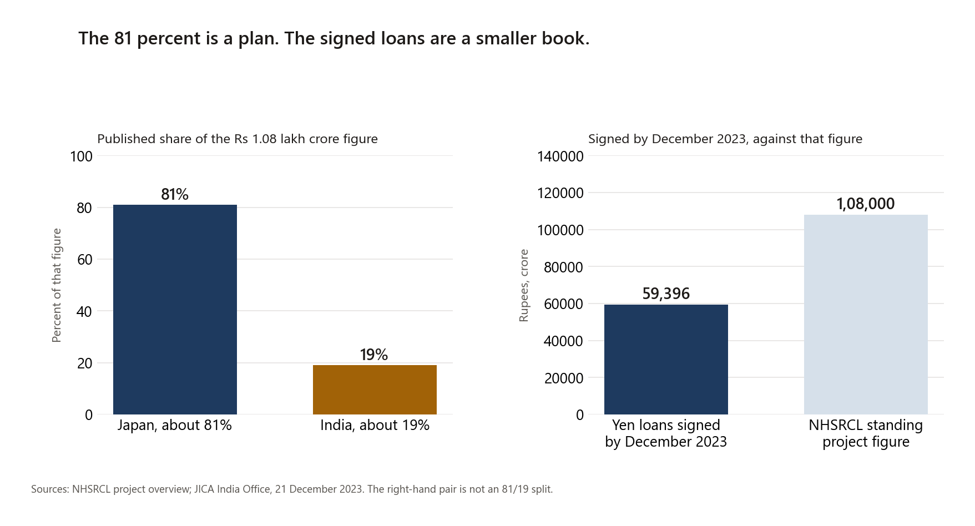 Figure 5. The left-hand pair is the split NHSRCL still publishes. The right-hand pair is what JICA had signed by December 2023, set beside that same standing figure. The right-hand pair is not an 81/19 split
.
Four clauses decide whether the cheap rate is as generous as it sounds.
The interest rate is concessional. It sits far below what the Government of India pays to borrow in rupees. The gap between 0.1 percent and the government’s own cost of funds is the subsidy inside the loan. A project whose financial return is only 4 percent can be carried when most of the capital carries that subsidy. Remove the subsidy and 4 percent does not cover the money.
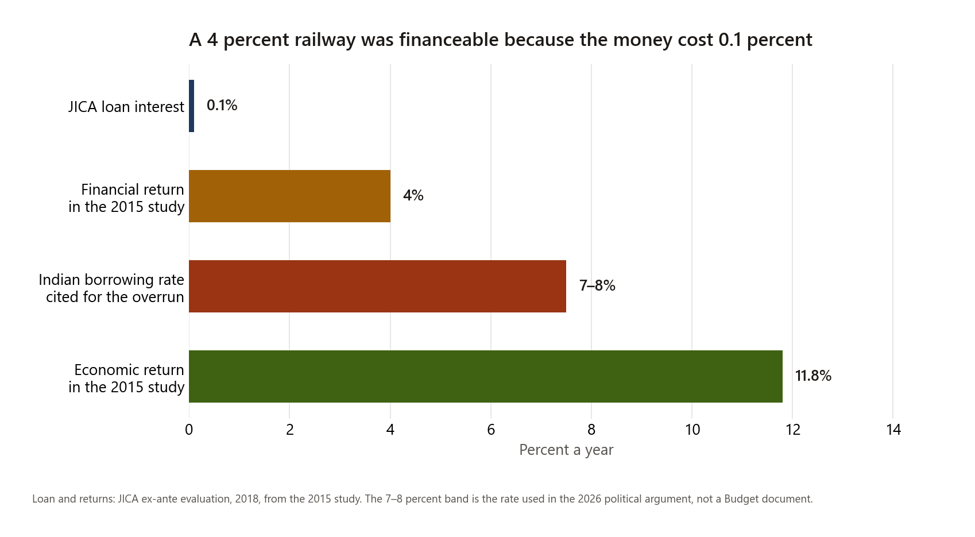 Figure 6. The loan rate and the two returns from the 2015 study. The 7 to 8 percent band is the Indian borrowing rate used in the 2026 argument over the overrun. It is not a rate from the Budget documents.
The grace period moves the pain into the future. For 15 years India pays a very small interest bill and does not repay principal. Early cash flows can look comfortable even if ridership disappoints. Principal falls due in the 2030s and 2040s. A delay of the opening into the late 2020s does not, by itself, produce a repayment crisis. It does raise the cost of building. That is a different bill, and it arrives sooner.
The loan is denominated in yen. India carries the exchange risk. If the yen rises against the rupee, the rupee cost of the same yen instalment rises, while the coupon remains 0.1 percent. A soft interest rate and a currency exposure sit in the same contract. What India will pay in rupees depends on the yen-rupee rate in the years the principal comes due.
The loan is tied, and it was sized off the original estimate. JICA’s 2018 evaluation states that the two governments agreed to apply a tied loan so that the technology and knowledge of Japan would be used. A tied loan spends a defined part of the money on the lender’s supply. The Japanese share was framed as about 81 percent of the cost then estimated. The commitments actually signed by December 2023, about ₹59,396 crore, were still short of an 81 percent share of a ₹1.08 lakh crore project. Rupees above the signed loans are Indian budget money, unless a further loan is agreed. [5] [8] [9]
Who in Japan the credit was built to help
The firms inside the project from the study stage were Japan International Consultants for Transportation, Oriental Consultants Global, and Nippon Koei. After the memorandum, Japanese consultants prepared the detailed design and the tender documents, and they supervised construction. The training institute, and the engineers sent to NHSRCL, were part of the same transfer. This is the Make in India the 2015 note described: Indian personnel trained on a Japanese system, and know-how moved into an Indian company. [1] [4] [5]
The commercial prize was the equipment. JICA’s project description includes rolling stock, track, electrical and mechanical systems, signalling and communications, and the operations control centre, alongside the civil works. The civil works were always going to be largely Indian. Dividing ₹1.08 lakh crore across a list of Japanese manufacturers uses the wrong denominator. The tied benefit is the system and the advice.
Part of that system has since been awarded elsewhere.
In May 2025, NHSRCL gave the signalling and telecom contract to a consortium of Dineshchandra R. Agrawal Infracon, Siemens Ltd, and Siemens Mobility. The contract was reported at about ₹4,100 crore. Siemens’ exchange filing put its own share at about ₹1,230 crore, for design, installation, and maintenance, with execution over 54 months and maintenance support for 15 years. The technology is European Train Control System Level 2, specified to support speeds up to 350 km/h. An earlier NHSRCL description of the corridor had pointed to Japan’s digital Shinkansen automatic train control. The contract that was signed is a European standard. [16]
A former Japanese minister wrote that this departed from an understanding that equipment, construction, contracts, and consultancies would be shared between Indian and Japanese companies, and that adopting a European train-control system pushed Japanese rail technology out of the project. The Ministry of External Affairs, through spokesperson Randhir Jaiswal, said that no Japanese offer had been received for the package, that the equipment had been ordered to international specifications, and that execution was in line with the aim of starting high-speed service as early as possible. [17] Both statements belong in the record. Together they show that the 2015 package is no longer being bought as one system.
The trains are in the same unfinished state. Parliament has been told that Japan has proposed E10 Shinkansen sets for the corridor, that those sets are still under development in Japan, and that the specifications and the schedule are still to be settled between the two sides. The same answer says that Integral Coach Factory, with BEML, is designing Indian high-speed trainsets with a design speed of 280 km/h, in line with Make in India. [10] Reporting in 2026 has said the first section is expected to open with the Indian sets, because the E10 will not be ready, with accounts of the Japanese train ranging from the early 2030s to 2034. The parliamentary figure to use is the 280 km/h design speed. Any year attached to the E10 is a press report until the two governments publish a schedule.
The bargain can be stated without decoration. Japan priced the money at 0.1 percent because Japanese industry was to supply the system that makes a Shinkansen a Shinkansen. India is building the civil works at home, buying signalling from a Siemens consortium, and building the first trains at BEML, while still drawing the yen. That can be defended as the faster road to an opening. It is also a change in what the concession was paying for.
The deadlines that were written down
Two opening commitments are in the documents. Both have passed.
The Railway Ministry’s note of 13 December 2015 said the project would be implemented in seven years. Counted from the memorandum, that pointed to about 2022. [1] The foundation stone was laid in Ahmedabad on 14 September 2017, on the visit during which the first loans were signed the following day. JICA’s evaluation of the second loan, agreed on 29 October 2018, said the project would be complete when the facilities entered service in December 2023, inside a schedule running to December 2025. [5] [6] December 2023 arrived with no passenger service. So did December 2025.
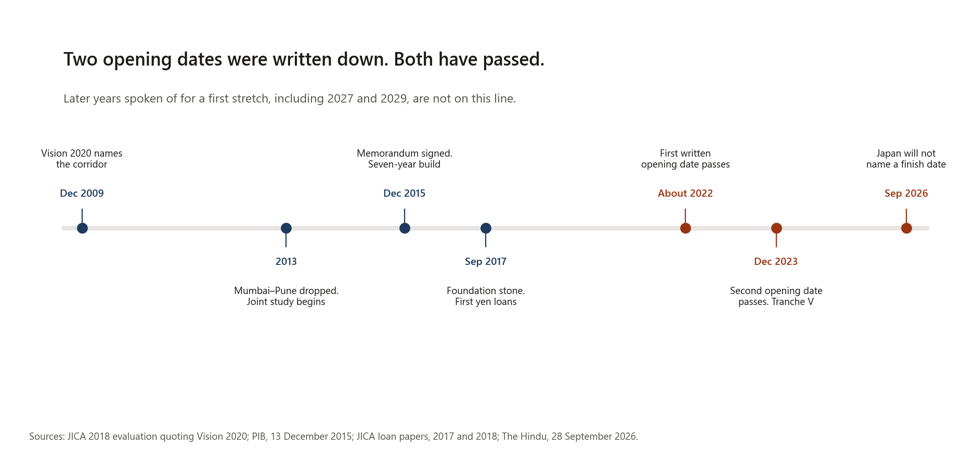 Figure 7. Dates that are in a document. Years since spoken of for a first stretch, including 2027 and 2029, are not plotted, because they are not yet written down the way 2022 and 2023 were.
What is said now is a new target, not a third date from the original contract. Reporting in 2026 has put a first stretch in Gujarat, discussed as Surat–Vapi or about 100 kilometres, at the end of 2027, and has sometimes put the full 508 kilometres at 2029. On 28 September 2026 a senior official of Japan’s Ministry of Foreign Affairs told The Hindu that the pace had not lived up to Japan’s initial expectations, that Japan was not in a position to say when the project would be completed, and that the work was nonetheless making steady progress. [18] That is the lender’s government declining to put its name to a date.
There is a serious reply to the charge of delay, and it should be heard. Masafumi Shukuri, chairman of the Japan Transport and Tourism Research Institute and of the International High-Speed Rail Association, told The Indian Express that the size of the job is the relevant fact. Japan opened its first high-speed line in 1964. Shukuri said that even today’s Japan could not build 500 kilometres of high-speed railway in ten years. A first line, a creek tunnel, and land to be acquired in two states was never a short civil contract. [19] The date of about 2022 in the 2015 press note was an ambition. December 2023, still in the loan paper three years after the foundation stone, was the date the two governments were using. Both passed. Shukuri’s point is that the miss was built into the promise.
JICA had already flagged the mechanism. Its 2018 evaluation noted that Indian railway projects slip when agencies outside the contract sit in the chain of approval, and that contractors were uneasy about partial-opening targets the executing agency had set which were not in the contract. The argument over the calendar was visible in the lender’s own file. [5]
Three costs, and why they are not the same number
The public argument has collapsed three different figures into one “cost of the bullet train.” They measure different things.
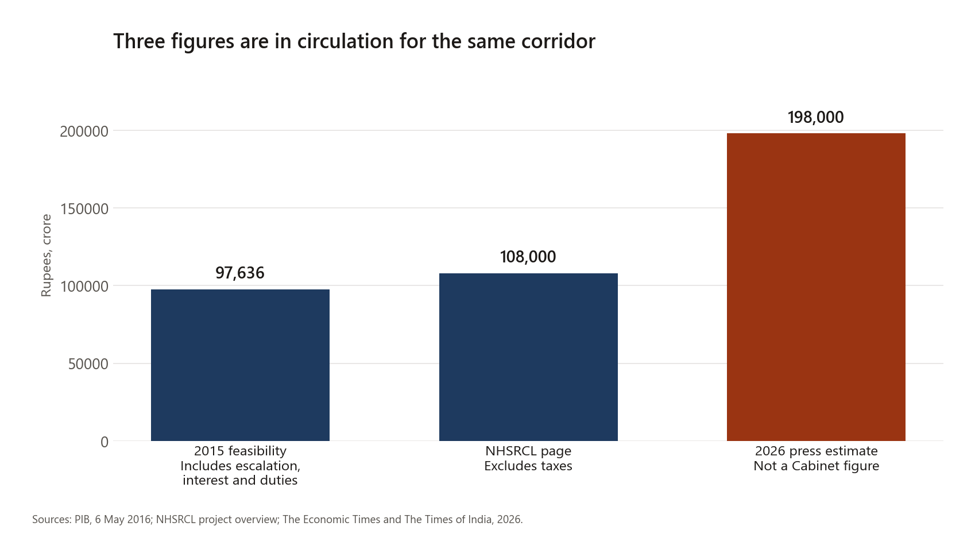 Figure 8. The three costs, in ₹ crore. The first includes escalation, interest during construction and duties. The second excludes taxes. The third is what officials told newspapers in 2026. It is not a Cabinet-approved estimate.
The July 2015 feasibility study, reported to Parliament in May 2016, estimated a completion cost of about ₹97,636 crore. That figure already included price escalation, interest during construction, and import duties. [3] NHSRCL’s project page still says ₹1,08,000 crore excluding taxes, and still says Japan funds about 81 percent. [9] In 2026, officials told The Economic Times and The Times of India that the cost had reached nearly ₹1.98 lakh crore, a rise of about 83 percent, or roughly ₹90,000 crore, which they attributed largely to the years lost in acquiring land. They said the ministry would take a revised estimate to the Cabinet, seek funds from the finance ministry, and meet the increase from the railway budget rather than ask JICA for another loan. The Economic Times also reported that the Budget estimates for 2026–27 had set aside ₹15,000 crore of gross budgetary support for NHSRCL, against ₹15,500 crore in the year then current. Those two budget lines should be read in the Budget documents themselves before they are repeated as appropriations. [13] [14]
NHSRCL has answered the claim that Japan will not fund the increase. The company said the agreement between India and Japan is comprehensive, that speculation to the contrary has no basis, and that the project continues to be backed by one of the most concessional sovereign loans ever extended for infrastructure, with very low interest and a long repayment. It added that Indian projects of a similar scale, in highways, metro rail, and airports, have revised their estimates after detailed design and tendering. [15]
Until a Cabinet note is published, the honest position is the following. ₹97,636 crore and ₹1,08,000 crore are published project figures, and they are not the same measure: one includes duties and interest during construction, the other is the company’s figure excluding taxes. About ₹1.98 lakh crore is what officials have told newspapers, ahead of a revision the Cabinet has been asked to approve. NHSRCL disputes the further claim that Japan has stepped out of the funding. The higher number is a reported estimate. It is not yet an approved cost.
The composition of the money matters even if the Cabinet later chooses a different total. The financial return of about 4 percent was calculated for a project in which most of the capital cost 0.1 percent. Rupees the yen loan does not cover come from the Budget, or are borrowed at the Indian government’s own rates. Critics of the escalation have put those rates around 7 to 8 percent. Every extra year adds escalation and interest during construction. Every extra rupee financed at Indian rates pulls the average cost of capital up toward a return that was only 4 percent on the original sum.
Fares should be left out of this until they come from the feasibility study or from the railway. A political claim that the Mumbai–Ahmedabad ticket was projected near ₹3,000, and might become ₹6,000 or ₹7,000, is not a tariff.
What forced the rethink
The delay has a sequence. Land came first. Time was lost above all in Maharashtra, in Palghar, Thane, and at the Mumbai terminal. Gujarat moved earlier. A change of government in Maharashtra in 2019 slowed decisions, and the pandemic then stopped work that had barely begun. JICA’s evaluation had already said that approvals sitting outside the executing agency delay Indian railway projects. That is the engine. The rest follows it. [5]
The bill follows the clock. A job that runs years past its estimate pays more for materials, labour, and interest during construction. The concessional loan was calculated on the old estimate. Whether or not Japan signs another tranche, the years already consumed have a rupee cost.
The technology package came apart later, and for a different reason. The corridor was adopted as a Shinkansen: trains, signalling, and control from one family of technology, which is what the tied loan was for. Signalling has gone to a Siemens consortium on a European standard. The first trains being designed in India have a design speed of 280 km/h. The service the project was described as offering was in the region of 320 km/h, on a line spoken of as capable of 350. Japan’s proposed E10 is still being designed. An opening of a priority section in 2027 on Indian sets would put the first passengers on a different railway from the one named in the 2015 memorandum. Japan has called the signalling decision a breach. India has called it a lawful procurement, made so that service can start. One package has become three: Japanese money and design, European signalling, and Indian trains. [10] [16] [17]
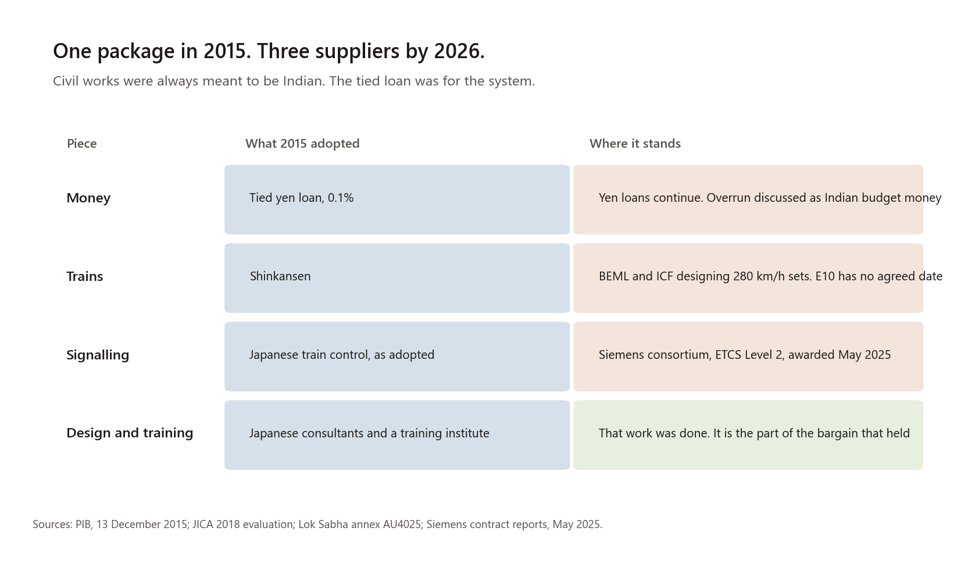 Figure 9. What the 2015 memorandum adopted, and where each piece stands. Civil construction was always going to be largely Indian. Design and training are the part of the Japanese role that was carried through.
The map beyond this corridor has changed as well. In the Union Budget for 2026–27, the Finance Minister proposed seven high-speed rail corridors as “growth connectors”: Mumbai–Pune, Pune–Hyderabad, Hyderabad–Bengaluru, Hyderabad–Chennai, Chennai–Bengaluru, Delhi–Varanasi, and Varanasi–Siliguri. [20] The speech itself does not attach a length or a cost to them. The same day, Railway Minister Ashwini Vaishnaw said the seven together span nearly 4,000 kilometres and are expected to attract investment of about ₹16 lakh crore. [21] Briefings around those corridors have discussed multilateral finance, special-purpose vehicles, a partnership of the Centre and the states, and property development around stations. Japanese companies have also been invited into the future network, and official statements have continued to speak of the E10 as a later train for India.
Mumbai–Pune is back on the list, thirteen years after the Railway Board set it aside as too costly a ghat for the first line. That is the policy shift worth naming. This corridor can remain a Japanese-financed project. The rest of the map is no longer being offered as seven more copies of the same tied loan.
What a 4 percent return can still support
The two rates of return answer different questions. The financial return, about 4 percent, asks whether fares and other income from the stations can pay for the railway as a business, over a life of 30 years. The economic return, about 11.8 percent, asks whether the country is better off once saved time, saved fuel, fewer accidents, and less pollution are counted. JICA calculated both from the feasibility study. A line can be worth building for the economy and still be a weak business for the company that runs it. The Japanese loan is what made the weak business financeable. [3] [5]
The asset is real. This is a separate railway of 508 kilometres, mostly on viaduct, with a tunnel under a creek, twelve stations, a training institute, a company created to own it, and a sovereign loan that remains unusually cheap. Land has been taken. On long stretches in Gujarat the piers are already in the ground. The question of whether anything is being built has been answered by the construction.
The case that was signed in 2015 has moved. Demand in the loan paper was built for an opening in 2023: about 30,000 passengers a day at Mumbai and about 21,000 at Ahmedabad, rising about fivefold by 2053, with about 70 train operations a day and an operating rate of 87.5 percent two years after the start. [5] Those passengers have not had a train to board. The cost now being discussed is much higher, and the share of it that sits on Indian rates is the share the 0.1 percent loan was supposed to keep small. The first trains, if they run in 2027, are the Indian sets, designed for a lower speed than the Shinkansen service the memorandum named.
Three figures, none of them in this article because they are not yet fixed, will settle the argument after it is published. The Cabinet’s revised cost will show how much Indian-priced capital the corridor now requires. The fare will show whether the financial return was drawn on a ticket ordinary business travellers will buy. The speed, and the number of trains, on the first section will show whether the railway that opens is the one the feasibility study measured. The viaducts are substance. The return, at the new cost and on the new timetable, is the question still open.
References
1. Press Information Bureau, Ministry of Railways, “India and Japan ink three agreements for cooperation in Railway Sector,” 13 December 2015. https://pib.gov.in/newsite/PrintRelease.aspx?relid=133138
2. Ministry of External Affairs, “List of documents exchanged during the visit of Prime Minister Shinzo Abe of Japan to India,” 12 December 2015. https://www.mea.gov.in/bilateral-documents.htm?dtl/26177/List_of_documents_exchanged_during_the_visit_of_Prime_Minister_Shinzo_Abe_of_Japan_to_India_in_New_Delhi_December_12_2015
3. Press Information Bureau, Ministry of Railways, “Mumbai-Ahmedabad High-Speed Rail Corridor,” written reply in the Rajya Sabha, 6 May 2016. https://pib.gov.in/newsite/PrintRelease.aspx?relid=144992
4. Japan International Cooperation Agency and Ministry of Railways, Joint Feasibility Study for Mumbai–Ahmedabad High Speed Railway Corridor, July 2015. https://www.jica.go.jp/Resource/english/our_work/social_environmental/id/asia/south/india/c8h0vm00009v1ylc-att/c8h0vm0000bzv4e5.pdf
5. Japan International Cooperation Agency, ex-ante evaluation, “Project for Construction of Mumbai-Ahmedabad High Speed Rail (II),” loan agreement 29 October 2018. https://www2.jica.go.jp/en/evaluation/pdf/2018_ID-P279_1_f.pdf
6. Japan International Cooperation Agency, ex-ante evaluation, “Project for the Construction of Training Institute for Mumbai-Ahmedabad High Speed Rail,” loan agreement 15 September 2017. https://www2.jica.go.jp/en/evaluation/pdf/2017_ID-P264_1_f.pdf
7. Japan International Cooperation Agency, “Signing of Japanese ODA Loan Agreements with India,” 22 December 2023. https://www.jica.go.jp/english/information/press/2023/20231222_30.html
8. JICA India Office, “JICA extends an ODA loan of INR 22,627 crores for the Mumbai-Ahmedabad High Speed Rail Project (V),” 21 December 2023. https://www.jica.go.jp/english/overseas/india/information/press/2023/20231221.html
9. National High Speed Rail Corporation Limited, project overview. https://www.nhsrcl.in/en/project/project-overview
10. Lok Sabha, unstarred question, annex AU4025, answer on E10 Shinkansen sets and indigenous high-speed trainsets. https://sansad.in/getFile/lsapps/loksabhaquestions/annex/188/AU4025_ArGedu.pdf
11. Ministry of Railways, Indian Railways: Vision 2020, December 2009. Quoted in the JICA evaluation at reference 5 as setting out priority high-speed tracks, including Mumbai–Ahmedabad.
12. G. Raghuram and Prashanth D. Udayakumar, “Dedicated High Speed Rail Network in India: Issues in Development,” Indian Institute of Management Ahmedabad, W.P. No. 2016-03-58, March 2016. https://www.iima.ac.in/sites/default/files/rnpfiles/10701585992016-03-58.pdf
13. The Economic Times, “Railways may absorb Rs 90,000 cr bullet train cost overrun.” https://economictimes.indiatimes.com/industry/transportation/railways/railways-may-absorb-rs-90000-cr-bullet-train-cost-overrun/articleshow/128988911.cms
14. The Times of India, “Railways unlikely to seek extra loan from JICA to meet higher cost of Bullet train project.” https://timesofindia.indiatimes.com/business/india-business/railways-unlikely-to-seek-extra-loan-from-jica-to-meet-higher-cost-of-bullet-train-project/articleshow/128987846.cms
15. ET Infra, “Cost escalation of bullet train project not entirely on railways: NHSRCL.” https://infra.economictimes.indiatimes.com/news/railways/cost-escalation-of-bullet-train-project-not-entirely-on-railways-nhsrcl/129136365
16. The Economic Times, “Siemens-led consortium wins Rs 4,100 crore contract for bullet train signalling, telecom work,” reporting Siemens’ exchange filing. https://economictimes.indiatimes.com/industry/indl-goods/svs/engineering/siemens-led-consortium-wins-rs-4100-crore-contract-for-bullet-train-signalling-telecom-work/articleshow/121902907.cms
17. The Tribune, “Japanese former minister says India violated bullet train pact; MEA rejects charge.” https://www.tribuneindia.com/news/top-headlines/japanese-former-minister-says-india-violated-bullet-train-pact-mea-rejects-charge/
18. Kallol Bhattacherjee, “Mumbai-Ahmedabad bullet train timeline fails to meet Japan’s expectations, but is now ‘moving forward’,” The Hindu, 28 September 2026. https://www.thehindu.com/news/national/mumbai-ahmedabad-bullet-train-timeline-fails-to-meet-japans-expectations-but-is-now-moving-forward/article71519932.ece
19. The Indian Express, interview with Masafumi Shukuri, “Even Japan can’t build a 500-km bullet train in 10 years.” https://indianexpress.com/article/business/india-bullet-train-not-delayed-even-japan-cant-do-it-10-yrs-high-speed-rail-body-head-10908311/
20. Ministry of Finance, Budget Speech 2026–27, paragraph 40. https://www.indiabudget.gov.in/doc/Budget_Speech.pdf
21. Press Information Bureau, remarks of the Union Minister for Railways, Ashwini Vaishnaw, on the seven high-speed corridors, 1 February 2026. https://www.pib.gov.in/PressReleasePage.aspx?PRID=2221838